
Why Did Genesee County Tear Down a Subdivision
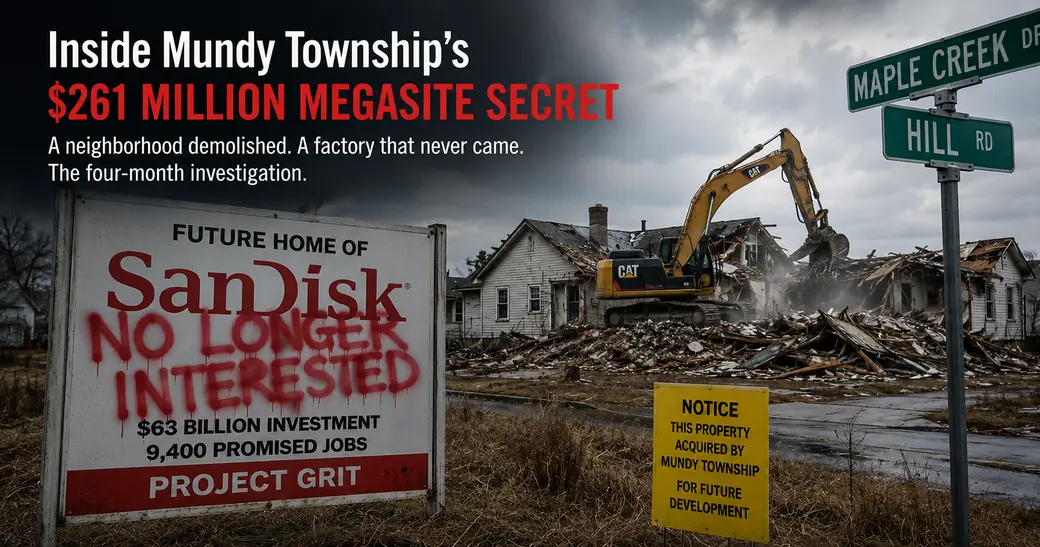
Why Did Genesee County Tear Down a Subdivision for SanDisk? Inside Mundy Township’s $261 Million Megasite Secret
A four-month Bridge Michigan investigation revealed how state and township officials quietly assembled a 1,300-acre megasite, signed more than 100 NDAs, and demolished a Flint-area neighborhood — for a SanDisk factory that never came.
Mundy Township in Genesee County has demolished close to half of about 155 homes it acquired to clear a 1,300-acre “megasite” for a $63 billion SanDisk semiconductor factory that the company canceled on July 16, 2025. The land assembly was funded by $261 million in Michigan state money and kept hidden from residents for more than two years through over 100 nondisclosure agreements. As of May 2026, no replacement company has committed, and demolitions are still going.
For Michigan homeowners — especially in Genesee, Oakland, and Macomb counties — the story is a cautionary tale about how quickly a “stable” subdivision can be reshaped by deals signed behind closed doors.
What Is the Mundy Township SanDisk Megasite?
The Mundy Township megasite is a roughly 2-square-mile property in the northwest corner of Mundy Township, bounded by Maple, Hill, Elms, and Linden roads, just south of Flint Bishop International Airport. The Flint & Genesee Economic Alliance, funded by $261 million in Michigan state grants, assembled more than 1,300 acres between 2022 and 2025. The original footprint was about 981 acres of farmland, but in 2024 the chipmaker — Western Digital, which spun off SanDisk in February 2025 to build the factory — demanded the full 2-mile span, forcing the inclusion of an entire subdivision called Maple Creek Preserve plus Morrish Elementary School.
The project was internally code-named “Project Grit.” SanDisk had proposed a 13 million-square-foot semiconductor complex with 9,400 promised jobs and a $63 billion private investment.
How Did the Township Keep It Secret?
Mundy Township officials signed nondisclosure agreements in spring 2022 — more than two years before most residents learned the full scope of the plan. Bridge Michigan’s four-month investigation, published in March 2026, documented the following:
-
More than 100 NDAs signed by state, local, and corporate parties
-
14 months of secret talks between township officials and the Michigan Economic Development Corporation (MEDC) before residents started asking questions
-
10 homeowners bought houses inside the megasite zone without being told their properties were already targeted for demolition
-
A $161,000 contract the MEDC paid marketing firm Moment Strategies to “mitigate any opposition”
-
A March 2023 board meeting where a resident asked directly about the rumored factory and was met with silence — the township attorney had instructed officials not to answer
Later in 2023, a resident petition with 1,600 signatures asking for a moratorium reached the township. The board took no action and continued telling organizers there was no specific proposal — even as a $20 billion incentive package was being offered to SanDisk in private, alongside a 50-year tax-free zone and the 1,300 acres at no cost to the company.
How Many Homes Were Torn Down?
About 155 homes had been acquired by early 2026, with close to half already demolished by March 2026, according to documents Bridge Michigan obtained under the Freedom of Information Act. Mundy Township Supervisor Jennifer Stainton — elected in fall 2024 on an anti-megasite platform — testified that 200 houses had been “torn down all for no reason” after SanDisk withdrew, a figure that includes perimeter homes demolished separately around the farmland core.
Demolition of the entire Maple Creek Preserve subdivision, roughly 90 homes built in 2004 and 2005, began in April 2026. Many of those properties had assessed values between $200,000 and over $300,000 — modern, well-kept homes, not blighted properties. The current demolition contract with Lurvey Construction of Flint runs through October 2026, with about $31.6 million in additional taxpayer money budgeted for the tear-downs.
What Does the SanDisk Megasite Mean for the Michigan Real Estate Market?
The Mundy Township story exposes three real-world risks that every Michigan homeowner and buyer should understand right now.
Overlay zoning can change in months, not decades. Mundy Township quietly approved an “Advanced Manufacturing Overlay District” covering roughly three square miles in May 2023. Many homeowners didn’t realize their parcels were inside it until the buy-offers showed up.
Title searches don’t reveal political risk. Ten buyers closed on houses inside the megasite zone with zero disclosure that the property was already on a demolition list. A clean title and a clean inspection report told them nothing about what was coming.
A state housing shortage didn’t stop the bulldozers. Michigan is short an estimated 119,000 homes, and Gov. Gretchen Whitmer announced a $1.4 billion housing plan in 2024 — yet $261 million in state money in the same window funded the destruction of usable middle-class housing in Genesee County.
For homeowners in the broader Metro Detroit and Flint markets, due diligence in 2026 now has to include overlay districts, planning commission minutes, and economic development plans — not just the deed and the inspection report.
Frequently Asked Questions
Was anyone forced to sell their home in Mundy Township?
No homeowner was condemned through eminent domain, but most residents of Maple Creek Preserve sold under significant pressure as utilities were shut off and neighbors moved out. A small number, including resident Don Ludwig, held out for years; Ludwig signed a sale agreement in late 2025.
Did Michigan recover any of the $261 million after SanDisk pulled out?
No. The $261 million was awarded through the Strategic Outreach and Attraction Reserve (SOAR) fund and used to buy land and prepare the site. SOAR was defunded by Michigan lawmakers in 2025, but the acquired land remains in the hands of the Flint & Genesee Economic Alliance with no current end user.
What is happening at the megasite right now?
As of May 2026, the Flint & Genesee Economic Alliance is “not currently in negotiations with any company,” according to executive director Tyler Rossmaessler. Demolitions are ongoing, and homeowners around the site perimeter are still being approached about selling.
Could a data center be built on the Mundy Township site instead?
No. Project leadership confirmed in February 2026 that data centers are excluded because they do not create enough jobs. The site is being marketed to advanced manufacturing in automotive, defense, and life sciences.
Did Morrish Elementary School get sold to the megasite?
No — and the school is still operating. The Flint & Genesee Economic Alliance publicly unveiled a $40 million offer in June 2025 to buy Morrish Elementary and 9 surrounding acres, with enough money to build a replacement school for the roughly 400 students who attend. After a contentious six-hour meeting, the Swartz Creek Community Schools Board of Education unanimously rejected the offer on October 22, 2025, and voted to hire an outside law firm to investigate two years of quiet negotiations between district administrators and developers. Talks formally ended shortly after when the alliance held firm at $40 million and the district did not counter.
The Takeaway for Michigan Homeowners and Buyers
The Mundy Township SanDisk story is what happens when a community’s real estate is treated as raw material for an economic development deal the community itself is not told about. The houses are gone, the company never came, and the site sits empty. For anyone buying or selling property in Genesee County or anywhere in Mid-Michigan right now, the lesson is concrete: pull the township meeting minutes, read the overlay zoning map, and ask the questions the township is hoping nobody asks.
Categories
Recent Posts







GET MORE INFORMATION